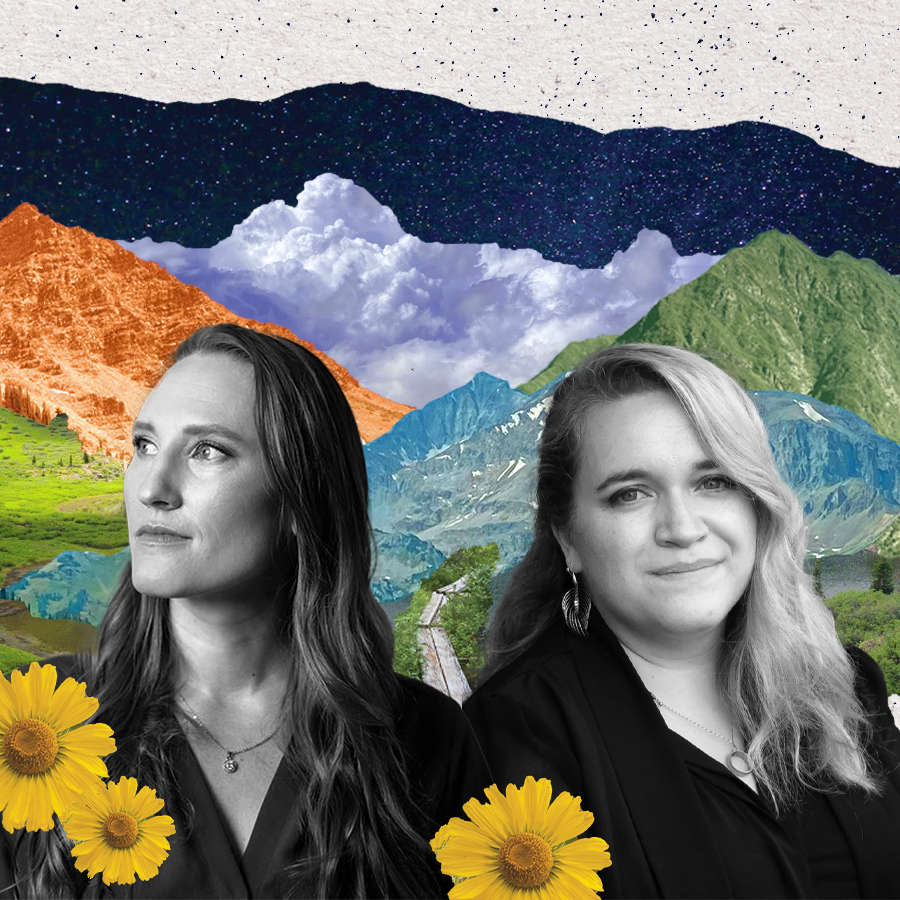
The way that cannot be followed alone…
PROGRAM NOTES & SONG TEXTS
The title of today’s recital, “The way that cannot be followed alone…” is borrowed from a letter by American photographer Ansel Adams. In this letter to his closet friend and mentor, photographer Cedric Wright, Adams transcribes his personal revelations after witnessing a large thunderstorm in Yosemite National Park. His words address the pathways of life, and the relationships and connections we form while surrounded by the lands that raise us. This program is an homage to both American song from the past 100 years and the unique landscapes that have shaped the history and the people of the United States.
The texts of these songs exemplify the poetic practice of seeing oneself or one’s emotions mirrored in the landscape and the reaching for nature analogy when descriptions of our own forms are insufficient. These words artfully reveal how our connections to landscape define and re-define the topography lines of our identities and interpersonal lives. “Landscapes” defined may include spaces with or without man-made features and are both visual and experienced. The places we inhabit are witness to us, to our joys and sorrows, accompanying our daily lives and memories while also providing resources for living. What do we owe one another for such dedicated companionship?
“Every love has a landscape.” These words penned by Rebecca Solnit echo the sentiments of the first set, with songs influenced by Black American music traditions. We move with the winds of love’s intensity and tenderness in Undine Smith Moore’s “Love Let the Wind Cry” and feel the weight of heartache and loneliness with Rufus Wainwright’s cabaret song “True Loves” and Leslie Adams’ “Sense You Went Away”.
The second set opens with the first movement of George Crumb’s Apparition, setting up a space of liminality through Walt Whitman’s text that exalts Night as the ancient entity of both death and life. We see and hear golden hour in Puerto Rican composer Carlos Cabrer’s “Canción” and Rebecca Clarke’s pastoral song “June Twilight”, then experience dual feelings of grief and connection that come with endings and beginnings in NH born songwriter Connie Converse’s lilting song “How Sad, How Lovely.”
Our second half opens with Ives’ “The Housatonic at Stockbridge,” originally for orchestra and later recomposed as a song. This piece utilizes the element of water, its constant movement, and its association with deep memory and longing as heard in Libby Larsen’s “Raspberry Island”. The set includes Claire’s original medley of the late Ella Jenkins’ song “Wake Up Little Sparrow” and the American spiritual “I’m a Poor Wayfaring Stranger.”
Our final set celebrate works that capture the rapturous vulnerability of an open heart, requiring patience and nurturing like forests and gardens. We close with another poignant Connie Converse’s tune, which expresses the desire to bloom and requests, “tell me how to be a lily, if you know.”
Landscape and song are palimpsests of our cultural histories. While “growth” is demanded, while change is rapid, and while the arts are continually undervalued, the voices behind these words and this music instead urge us to be present, to observe, to feel, and to connect.
Thank you for being present with us.
PROGRAM TEXTS
I’ve Got the Sun in the Morning
Got no diamonds, got no pearls,
Still I think I'm a lucky girl.
I've got the sun in the morning
And the moon at night.
Got no mansion, got no yacht,
Still I'm happy with what I got.
I've got the sun in the morning
And the moon at night
Sunshine gives me a lovely day,
Moonlight gives me the Milky Way.
Got no checkbooks, got no banks,
Still, I'd like to express my thanks.
I've got the sun in the morning
And the moon at night.
And with the sun in the morning
And the moon in the evening
I'm alright.
Love Let the Wind Cry
Love let the wind cry on the dark mountain,
Bending the ash trees and the tall hemlocks
With the great voice of Thunderous legions,
How I adore thee.
Let the hoarse torrent in the blue canyon,
Murmuring mightily out of the gray mist
Of primal chaos, cease not proclaiming
How I adore thee.
Let the long rhythm of crunching rollers,
Breaking and bursting on the white seaboard
Titan and tireless, tell, while the world stands,
How I adore thee.
Love, let the clear call of the tree cricket,
Frailest of creatures, green as the young grass,
Mark with his trilling resonant bell-note,
How I adore thee.
But, more than all sounds, surer, serener,
Fuller of passion and exultation,
Let the hushed whisper in thine own heart say,
How I adore thee.
True Loves
A heart of ice is easily melted
A heart of stone is easily thrown away
It's the true loves
That make me want to cry
It's the true loves
That make me want to say goodbye
A heart of ice is easily molded
A heart of stone is easily hidden away
It's the true loves
That make me want to cry
It's the true loves
That make me want to say goodbye
So take your true loves down to the river
And I will watch you here on the corner
And if you need me I'll always be here
A heart of stone never goes anywhere
Sence You Went Away
Seems lak to me de stars don't shine so bright,
Seems lak to me de sun done loss his light,
Seems lak to me der's nothin' goin' right,
Sence you went away.
Seems lak to me de sky ain't half so blue,
Seems lak to me dat ev'ything wants you,
Seems lak to me I don't know what to do,
Sence you went away.
Seems lak to me dat ev'ything is wrong,
Seems lak to me de day's jes twice as long,
Seems lak to me de bird's forgot his song,
Sence you went away.
Seems lak to me I jes can't he'p but sigh,
Seems lak to me ma th'oat keeps gittin' dry,
Seems lak to me a tear stays in my eye,
Sence you went away.
I. The Night In Silence Under Many a Star
The night, in silence, under many a star;
The ocean shore, and the husky whispering wave, whose voice I know;
And the soul turning to thee, O vast and well-veil’d Death,
And the body gratefully nestling close to thee.
Canción
Sonaba la tarde (The afternoon rang)
por los senderos; (on the pathways)
sonaba la tarde. (The afternoon rang)
Había una luz (there was a final light)
última en el aire (in the aire)
y en la rama alta (and on the old branches)
del chopo grande, (of the great poplar)
sonaba la tarde. (sounded the afternoon)
Caía del cielo (there fell from the sky)
un gozo, y el aire… (a joy, and the air…)
sonaba la tarde (the afternoon rang)
en el aire. (In the air)
Iba el corazón (the hear went along)
llenándose de alguien. (filling itself with someone)
Por los senderos (on the pathways)
sonaba la tarde. (The afternoon rang)
June Twilight
The twilight comes;
the sun dips down and sets,
The boys have done
play at the nets.
In a warm golden glow
The woods are steeped.
The shadows grow;
The bat has cheeped.
Sweet smells the new-mown hay;
The mowers pass
Home, each his way,
through the grass.
The night-wind stirs the fern,
A night-jar spins;
The windows burn
In the inns.
Dusky it grows. The moon! The dews descend.
Love, can this beauty in our hearts end?
How Sad How Lovely
How sad, how lovely,
how short, how sweet,
to see that sunset
at the end of the street.
And the day gathered in
to a single light,
and the shadows rising
from the brim of the night.
Too few, too few
are the days that will hold
your face, your face
in a blaze of gold.
How sad, how lovely,
how short, how sweet,
to see that sunset
at the end of the street.
And the lights going on
in the shops and the bars,
and the lovers looking
for the first little stars.
Like life, like a smile,
like the fall of a leaf,
how sad, how lovely,
how brief.
The Housatonic at Stockbridge
Contented river! In thy dreamy realm
The cloudy willow and the plumy elm:
Thou beautiful!
From ev’ry dreamy hill
what eye but wanders with thee at thy will,
Contented river!
And yet over-shy
To mask thy beauty from the eager eye;
Hast thou a thought to hide from field and town?
In some deep current of the sunlit brown
Ah! there’s a restive ripple,
And the swift red leaves
September’s firstlings faster drift;
Wouldst thou away, dear stream?
Come, whisper near!
I also of much resting have a fear:
Let me tomorrow thy companion be,
By fall and shallow to the adventurous sea!
Raspberry Island
My father loved spring floods. “Dont drive down to the river,” my mother would say when my father and I piled into the Ford. “H-m-m,” he replied. “H-m-m.” He drove slowly, pausing and pointing and not saying much. Ducks, he would say, watercress, mushrooms caves, Raspberry Island.
We sat there, not speaking for a while in the pleasant afternoon… two slender boats skimming along the river. “This used to be the place where people gathered- picnics, swimming, music” (my father said). And why not? Why not gather at the river?... All of us (should come). We’ll hear music… Here at the river, the beautiful, beautiful river.
Wake Up, Little Sparrow & Poor Wayfaring Stranger
Wake up, wake up
Little sparrow
Don't make your home
Out in the snow
Little bird,
Don't you know
Your friends flew south
Many months ago
You’re just a babe
You cannot fly
Your wings won't spread
Up against the sky
I’m just a poor wayfaring stranger,
A-trav’ling through this world of woe,
But there’s no sickness, toil, nor danger
In that bright land to which I go.
I’m going there to see my Mother,
I’m going there no more to roam,
I’m just a-going over Jordan,
I’m just a-going over home.
little
Little Stream
Little stream upon the mountainside
Water spirit be my guide
Teach me how to laugh and play
Let me learn from you to flow.
Longing to return to mother sea, you’re just like me
Making up a song as you go
Oh take me back, my friend
Little campfire in the night
Burning spirit of delight
Teach me how to see the light
Let me learn to warm the heart
Deep within your flame is father sun, all things are one
For he is my father too
Oh take me back, my friend
Made my bed beneath the cedar tree
Let the night winds speak to me
Tell me of the times that used to be
Tell me of the times to come
Oh Thou holy Earth what have we done? We me who live
Will there be the time to forgive?
Oh take me back, my friend,
Take me back with you
Take me back again.
I Have Considered the Lilies
I have considered the lilies
They never toil they only bloom
They never feel chilly, or tired, or silly
And they don’t need much room
I have considered the lilies
I have considered how they grow
Tell me, tell me how to be a lily
If you know
Oh lilies, toil not, neither do they spin
I'm gonna take my working papers
And turn them in
I'm handing over my pencil and pen
I won't be needing my broom again
I'll bloom by day, I'll bloom by night
And blooming will be my delight
White tigerlily still waterlily
See how they all dilly-dally
Look at the day lily, lemon lily, calla-lily
And the lovely little lilies of the valley
Oh lilies, toil not, neither do they spin
I'm gonna take my working papers
And turn them in
To be more splendid than Solomon
I'll walk around wearing the morning sun
The sun by day, the moon by night
And blooming will be my delight
It would be fun but I'm afraid that I would freeze
King Solomon was not arrayed like one of these
So lilies, I can't afford to dilly-dally
I've got to work for my cotton, work for my denim
Linen and damask and challis
Not like the day lily, lemon lily, calla-lily
And the lovely little lilies of the valley
I have considered the lilies
I have considered how they grow
Tell me, tell me how to be a lily
If you know